
Do brain games work? What the big studies actually found
You get better at the game you practise. Whether it spreads further is the hard part: what Owen, ACTIVE, the n-back studies and the meta-analyses found.

Photo: Winston Tjia / Unsplash
In a study published in Nature in 2010, 11,430 adults played short online games for six weeks, at least ten minutes a day, three times a week. One group practised reasoning and planning puzzles, another a mix of memory, attention, spatial and maths tasks. A third group spent the same time answering obscure trivia questions with whatever they could find online. Both game groups improved on every task they had practised. On a separate set of tests taken before and after, the two game groups did barely better than the trivia group.
That result is the whole debate in small. Do brain games work? At the games, yes: practise a task and you get faster and more accurate at it, and on that point the big reviews agree. What the best-controlled studies have not shown is that the gain travels: to different tests, to work, to remembering where you put your glasses. A few studies have found more than that, and they get a fair hearing below.
What follows goes through the studies that shaped that answer, why they sometimes disagree, and what you can reasonably expect from a logic game. The settlement with Lumosity's maker that the FTC announced in 2016, the two open letters of 2014 and the 2016 review by Simons and colleagues are in our comparison of Lumosity, Elevate, Peak and five other apps, and are not repeated here.
Practice and transfer
Researchers split the question in three.
- The trained task. You play a memory grid and your memory-grid scores go up. This is a practice effect, and it is the least disputed part of the field.
- Near transfer. You also do better on a different test that asks for much the same thing, say a grid with other shapes, or another short-term memory task.
- Far transfer. The gain shows up somewhere quite different: a reasoning test, school results, work, daily life. This is what most people mean when they ask whether brain games work, and it is where the evidence runs thin.
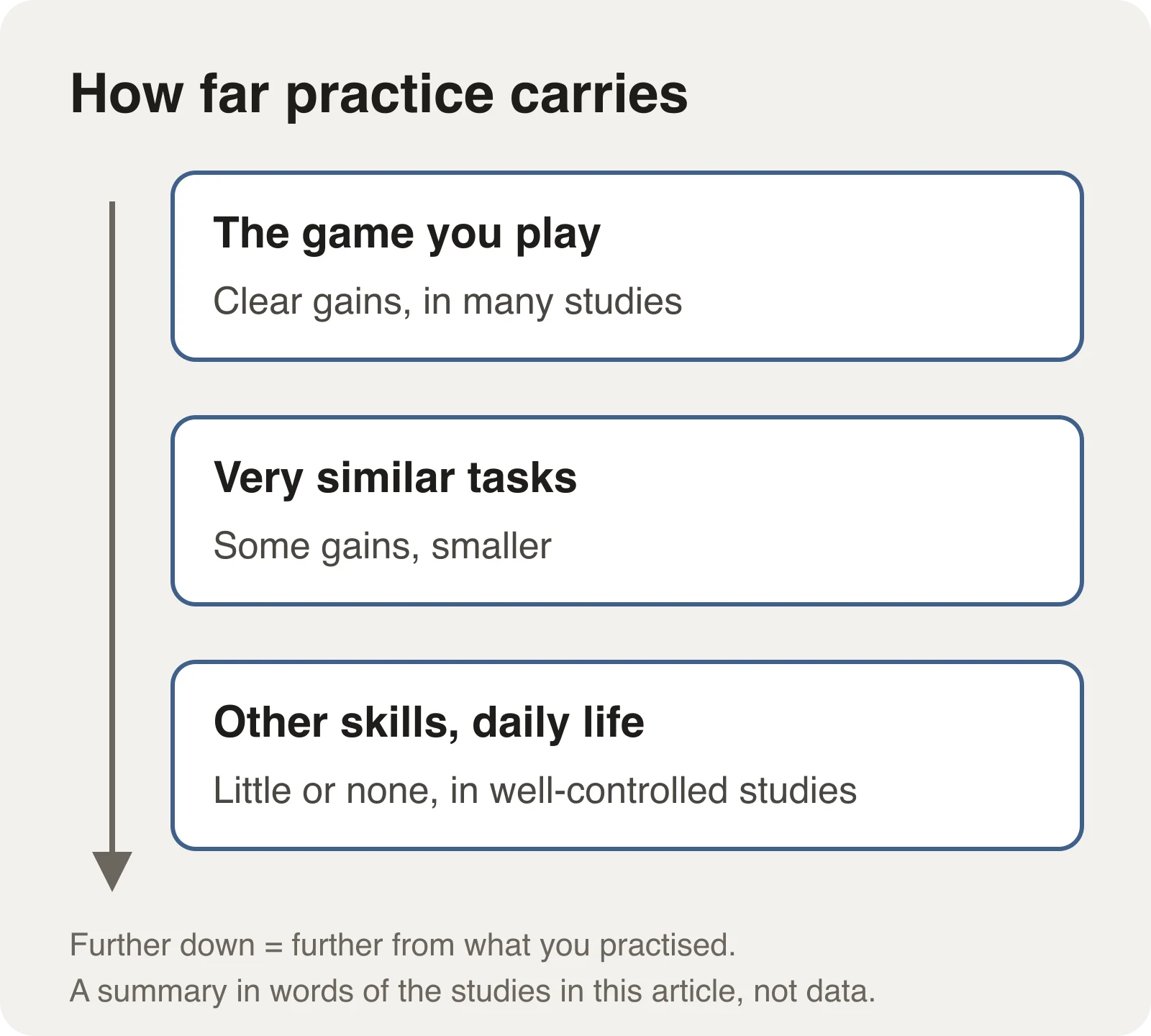
The rest of this article is, in one way or another, about the gap between the first step and the third.
The studies that shaped the answer
Owen and colleagues, 2010: eleven thousand people online
The study in the opening paragraph is by Adrian Owen and colleagues, and it was run entirely online, with participants aged 18 to 60. Its authors report that "improvements were observed in every one of the cognitive tasks that were trained", yet "no evidence was found for transfer effects to untrained tasks, even when those tasks were cognitively closely related". When the groups were compared on those tests, the effect sizes were, in their words, "very small".
Two things make it useful. The control group was active (it also spent its sessions online, just not on cognitive tasks), so the comparison is fair. And the sample was huge, so "no transfer" is not a matter of too few people. Its limit: the training lasted six weeks and nobody supervised it, so it says little about longer, supervised programmes.
ACTIVE: 2,832 older adults, ten sessions, ten years
ACTIVE is the longest-running trial in this list, and the easiest to over-read. In it, 2,832 volunteers aged 65 to 94 were assigned to one of three courses of ten group sessions (memory, reasoning, or speed of processing) or to a control group with no training.
- After two years (Ball and colleagues, JAMA, 2002), each course had improved the ability it targeted, "durable to 2 years". The trial found no effect of the training on everyday functioning at that point.
- After ten years (Rebok and colleagues, 2014), the reasoning and speed groups still did better than controls on the abilities they had trained; the memory group no longer did. Participants in all three groups also reported less difficulty than the control group with what researchers call instrumental activities of daily living (the National Academies give taking medication and driving as examples). That last measure was self-reported, and only 44% of participants were still in the study at ten years.
So ACTIVE is real evidence, and it is also not evidence about apps. The courses were taught in person, in small groups, by certified trainers over five to six weeks, with booster sessions for some participants later. In 2017 the US National Academies of Sciences, Engineering, and Medicine, whose view of cognitive training rested largely on ACTIVE, described the evidence for it as "encouraging but inconclusive". The same report listed the trial's weak points (a control group with no contact, many dropouts by years five and ten) and said there was no evidence that the long-term effects suggested by ACTIVE apply to commercial computer-based training apps, whose effects "appear to be short term".
The n-back story: one striking result, then the replications
An n-back task shows you a sequence and asks, at every step, whether the current item matches the one from n steps earlier. In 2008 Susanne Jaeggi and colleagues reported in PNAS that young adults who practised a demanding version of it (the dual n-back, with squares on a grid and spoken letters at the same time) scored higher on tests of fluid intelligence (reasoning about new problems), and that "the more training, the more improvement".
Then came the replications. Redick and colleagues (2013) gave young adults 20 sessions of adaptive dual n-back training and compared them with an active placebo group that practised visual search, and with a group that did nothing. Both trained groups got better at their own task; there was "no positive transfer to any of the cognitive ability tests", despite what the authors describe as high statistical power.
Researchers on both sides then pooled the studies, and the pooled results disagree with each other. A 2015 meta-analysis by Au, Jaeggi and colleagues, of 20 n-back studies with healthy adults aged 18 to 50, found "a small but significant positive effect" on fluid intelligence. A 2016 meta-analysis by Melby-Lervåg, Redick and Hulme, covering 87 publications on working-memory training in general, found short-term gains on other working-memory tests, but no convincing evidence of far transfer when training was compared with an active control group. Its conclusion: the programmes "appear to produce short-term, specific training effects that do not generalize".
That disagreement is worth reading closely, because it is mostly about method, which brings us to the next section.
The meta-analyses, and a meta-analysis of them
- Lampit, Hallock and Valenzuela (2014), 52 studies with 4,885 healthy older adults, found a small overall effect of computerised cognitive training on lab tests of memory, speed and spatial skills. Three details matter for anyone playing on a phone: "home-based administration was ineffective compared to group-based training", there was "no evidence" for working-memory training, and "only weak evidence" for sessions shorter than 30 minutes. The authors add that their results do not address how long any effect lasts.
- Sala, Tatlidil and Gobet (2018) pooled studies on video games, found small or null effects throughout and "no evidence of a causal relationship between playing video games and enhanced cognitive ability".
- Sala and colleagues (2019) went one level up and combined existing meta-analyses of working-memory training, video games, music, chess and exergames. Working-memory training did produce near transfer. Far transfer was small or null, and once placebo effects and publication bias were accounted for, the overall effect "equaled zero". Their conclusion is blunt: the lack of generalisation is "an invariant of human cognition".
Why the studies disagree
Positive and negative results often come from studies that differ in a few predictable ways, and the reviews above point to the same ones.
- The control group. Comparing players with people who did nothing (a "no-contact" control) mixes the effect of the games with the effect of expecting to improve, getting attention, and simply taking the tests twice. That is why Redick's study added an active placebo group, and why the 2016 meta-analysis looked separately at studies with one: against those, far transfer found no convincing support.
- Expectations. People who sign up for a study of cognitive training know what they are hoping for. Sala's team controlled for placebo effects explicitly.
- Publication bias. Studies with exciting results tend to get published more easily than studies with dull ones. In the 2016 and 2019 meta-analyses, correcting for it left little or nothing of the far-transfer effect.
- What counts as "far". A test that looks a lot like the training game is closer to near transfer than its label suggests, so it is worth checking what a study actually measured.
- Self-report. "I find daily tasks easier" is worth recording, but it is not the same as a measured change, and ACTIVE's ten-year results on daily life rest on it.
None of this means the positive studies are wrong. It means the strongest claims come from the designs that are easiest to fool, and the most careful designs tend to find the smallest effects.
What you can honestly expect from a logic game
Going by the studies above, here is a fair list.
- Practice usually makes you better at the game. Faster, fewer mistakes, higher scores. That is real, and it is satisfying, but it is a measure of how you do at that game.
- Very similar tasks: maybe, a little. Some studies find small gains there and others find none, so it is not something to count on.
- Do not expect it to make you better at work, at school or at remembering things in daily life. The well-controlled studies have not shown that, and in the reviews of older adults, unsupervised sessions at home are where the effects look weakest.
- Enjoyment is a fine reason to play. A puzzle is a challenge and a few quiet minutes, and that needs no promise attached.
No score on any game says anything about your health. If something about your memory or concentration worries you, that is a question for a doctor.
LogicGlow has 34 games. One of them, Two steps back, asks "Is this cell the one from N steps ago?", which makes it an n-back task, like the ones in the replications above that found no transfer beyond the task. Its site says that each game "levels up and adjusts the difficulty to you", which is "why two rounds are not comparable", and that LogicGlow "measures how you do and how that changes", "is not a medical tool" and "does not promise improvement". Going by the studies above, a rising score at Two steps back means you have got better at Two steps back.
Frequently asked questions
Do brain games make you smarter?
Not in any way the best-controlled studies have shown. You get better at the games you practise. Studies with active control groups, and the meta-analyses that pool them, find little or no gain on reasoning tests that differ from the training.
Do brain games help with memory?
They help with the memory games you play: your scores at those go up. In ACTIVE, older adults who took an in-person memory course still did better on memory tests two years later, but that advantage was gone by year ten. Evidence that games help with remembering things in daily life is weak. If your memory, or someone else's, worries you, talk to a doctor or another health professional.
Can brain games prevent dementia?
Not on the evidence so far. In its 2017 report, the US National Academies found no evidence that the long-term effects suggested by the ACTIVE trial apply to computer-based training apps. If dementia worries you, for yourself or someone close, talk to a doctor or another health professional.
Do brain games work for seniors?
Much of the research is on older adults, and the pattern is the same: clear gains on the trained tasks, small or uncertain gains elsewhere. The 2014 review of 52 studies found that training at home, unsupervised, was ineffective compared with group sessions.
Are logic puzzles good for your brain?
Logic puzzles are a good challenge and many people enjoy them. Whether they change anything beyond your skill at puzzles is the question the studies above have struggled to answer, and so far the answer is mostly no.
Sources
- Owen, A. M., Hampshire, A., Grahn, J. A., Stenton, R., Dajani, S., Burns, A. S., Howard, R. J. and Ballard, C. G., Nature 465, 775–778, 2010, doi:10.1038/nature09042, full text at PMC2884087, consulted 20 Oct 2026.
- Ball, K. and others for the ACTIVE Study Group, "Effects of cognitive training interventions with older adults: a randomized controlled trial", JAMA 288(18), 2271–2281, 2002, doi:10.1001/jama.288.18.2271, full text at PMC2916176, consulted 20 Oct 2026.
- Rebok, G. W. and others, "Ten-year effects of the ACTIVE cognitive training trial on cognition and everyday functioning in older adults", Journal of the American Geriatrics Society 62(1), 16–24, 2014, doi:10.1111/jgs.12607, full text at PMC4055506, consulted 20 Oct 2026.
- National Academies of Sciences, Engineering, and Medicine, 2017 report on dementia and age-related changes in thinking, Summary chapter and doi:10.17226/24782, consulted 20 Oct 2026.
- Jaeggi, S. M., Buschkuehl, M., Jonides, J. and Perrig, W. J., "Improving fluid intelligence with training on working memory", PNAS 105, 6829–6833, 2008, doi:10.1073/pnas.0801268105, consulted 20 Oct 2026.
- Redick, T. S. and others, "No evidence of intelligence improvement after working memory training: a randomized, placebo-controlled study", Journal of Experimental Psychology: General 142, 359–379, 2013, doi:10.1037/a0029082, consulted 20 Oct 2026.
- Au, J., Sheehan, E., Tsai, N., Duncan, G. J., Buschkuehl, M. and Jaeggi, S. M., "Improving fluid intelligence with training on working memory: a meta-analysis", Psychonomic Bulletin & Review 22, 366–377, 2015, doi:10.3758/s13423-014-0699-x, consulted 20 Oct 2026.
- Melby-Lervåg, M., Redick, T. S. and Hulme, C., meta-analytic review of working-memory training and far transfer, Perspectives on Psychological Science 11, 512–534, 2016, doi:10.1177/1745691616635612, consulted 20 Oct 2026.
- Lampit, A., Hallock, H. and Valenzuela, M., systematic review and meta-analysis of computerised cognitive training in healthy older adults, PLoS Medicine 11, e1001756, 2014, doi:10.1371/journal.pmed.1001756, consulted 20 Oct 2026.
- Sala, G., Tatlidil, K. S. and Gobet, F., "Video game training does not enhance cognitive ability: a comprehensive meta-analytic investigation", Psychological Bulletin 144, 111–139, 2018, doi:10.1037/bul0000139, consulted 20 Oct 2026.
- Sala, G., Aksayli, N. D., Tatlidil, K. S., Tatsumi, T., Gondo, Y. and Gobet, F., "Near and far transfer in cognitive training: a second-order meta-analysis", Collabra: Psychology 5(1), 2019, doi:10.1525/collabra.203, abstract at the University of Liverpool repository, consulted 20 Oct 2026.
- LogicGlow website, logicglow.app, consulted 20 Oct 2026.